
The Truce That Still Speaks
We live in a particularly divisive time. Political polarization is at its worst since the Civil War. Only now, social scientists have identified a different kind of division that is not merely based on differing ideologies. “Affective polarization,” is rooted in distrust, dislike, and contempt. and manifests as emotional hostility toward anyone perceived as being on the opposite side. Some even believe that disagreement is the same as treason.
With so much hostility across sociopolitical divides, will we ever be able to repair and rebuild trust? Will we ever be able to come together and focus instead on all we have in common? Our shared need for human connection? What would it look like if we could cross the divide of our differences?
And that brings to my mind, a true story I remember reading years ago about a Christmas Day pause in hostilities between American and German soldiers during WW II. To refresh my memory, I prompted ChatGPT to tell me about it.
After politely explaining that it was WWI and not WW II, and that it was between British and German soldiers, Chat GPT offered the following story. I find it inspirational.
Of note: the phrase “When the Guns Fell Silent: Christmas, 1914” is commonly associated with accounts of the Christmas Truce published in British newspapers shortly after the event occurred (AI does a good job sourcing these references). Also, a common headline/byline for journalists reporting in that era was simply “Staff Correspondent.” As you can see below, ChatGPT follows the tradition of the time.
“When the Guns Fell Silent: Christmas, 1914
By Staff Correspondent
On Christmas Day, 1914, something extraordinary happened on the battlefields of Europe.
In the frozen trenches of World War I, where mud, fear, and artillery had ruled for months, the guns went quiet. Not by command. Not by treaty. But by choice.
As dawn broke across no‑man’s‑land, British soldiers heard something unexpected drifting from the German lines—singing. Christmas carols, sung softly, hesitantly, in a language the listeners did not speak but instantly understood. Soon, British voices answered back.
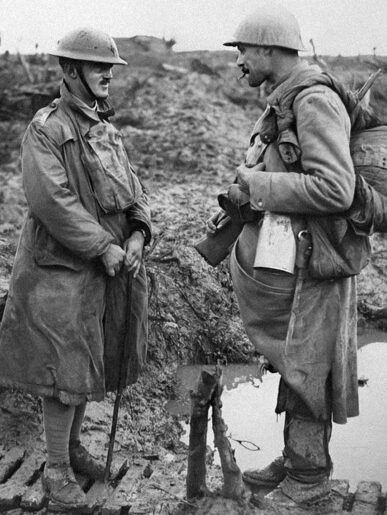
By midmorning, men who had been trying to kill one another the day before climbed out of their trenches. Rifles were left behind. Hands were raised not in surrender, but in greeting. They met in the open ground that had moments earlier been certain death.
They shook hands. They exchanged cigarettes, chocolate, buttons, and photographs of wives and children. Some prayed together. Others buried their dead. In at least one sector, they played an impromptu game of soccer on the frozen earth.
For a single day, the war forgot itself.
There were no speeches. No flags planted. No victory claimed. Just young men—farmers, clerks, teachers—remembering that before they were soldiers, they were human.
The truce was unofficial, brief, and discouraged by high command. By the following day, the killing resumed.
But that one Christmas remains.
It stands as proof that even in the darkest machinery of war, conscience can surface. That obedience has limits. That peace is not naïve—it is remembered.
More than a century later, the Christmas Truce endures not because it stopped the war, but because it revealed what the war could not destroy.
Humanity crossed no‑man’s‑land first.
And for one quiet day, it held.
Alan
Comments ( 2 )